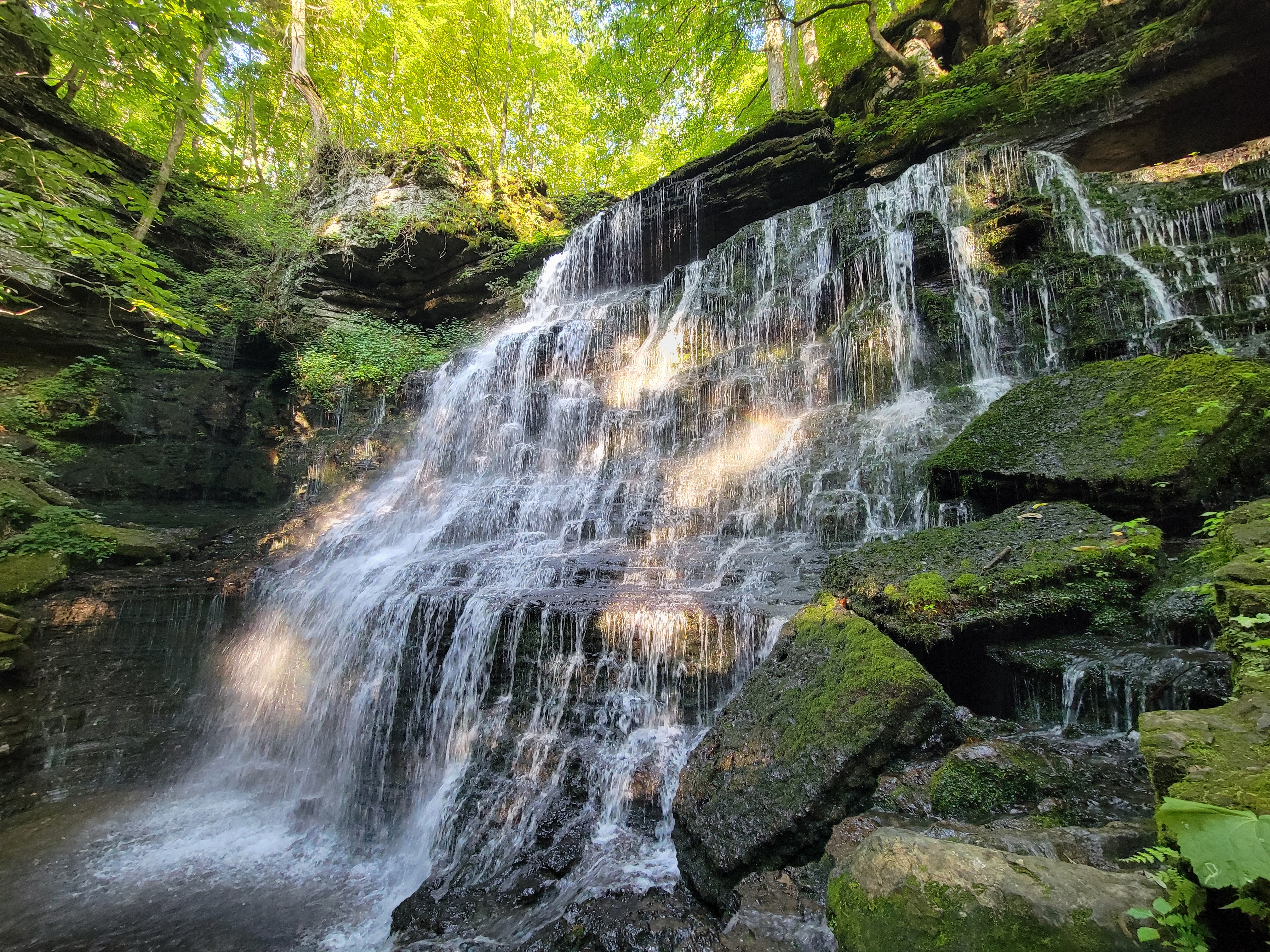
Machine Falls is the reason to come to Short Springs Natural Area. The other trails here are fine, the forest is pleasant, and the secondary falls are worth seeing in the right season. But the waterfall itself is the whole point, and it delivers in a way that makes the drive feel entirely worth it.
This is one of the first spots I visited, and one of a handful of places I have returned to more than once. Three visits across summer, winter, and spring, on slightly different routes. That kind of repeat attention says something about a place.
This guide covers both the short Machine Falls hike and the longer combined route that adds Adams Falls, Busby Falls, and the Laurel Bluff Trail. The honest framing upfront: if your goal is the best waterfall view, the shorter route gets you there. The longer loop is more about extra walking than extra payoff.
Trail stats and how to get there
Short loop: approximately 1.5 miles. Full combined loop with Adams Falls, Busby Falls, and Laurel Bluff: approximately 3 miles total. No entry fee. Dogs allowed on leash. This Tennessee state natural area is just 10, 15 minutes from downtown Tullahoma.
Parking is on Short Springs Road beside the water tower, with the trailhead directly across the street. A dozen or so spaces are available, which has been more than enough on my, admittedly off-peak, visits.
Short loop or long loop: which one is right for you?
The shorter loop
The short loop clocks in around 1.5 miles and focuses almost entirely on the waterfall. The overall difficulty is low. The main obstacles are summer heat, the rooty and uneven creek approach near the falls, and a staircase section depending on your direction of travel. If Machine Falls is your goal, this is the version to do. It wastes no time on secondary falls with limited view or uncertain flow.
The longer route: Adams Falls, Busby Falls, and Laurel Bluff
The full extended loop adds roughly a mile to the short version without affecting technical difficulty. The route passes Adams Falls and Busby Falls, and portions of the Laurel Bluff Trail. Do the longer loop if you want a fuller day out, enjoy walking for its own sake, or are visiting during a wet season when secondary falls may actually have decent flow. Skip it if the main waterfall is your primary goal or if time and energy are limited.
Clockwise vs counter-clockwise
Counter-clockwise gives you a gentler descent to Machine Falls, but the return involves climbing the staircase at the end when your legs are already tired. Clockwise puts the stairs on the descent and the gradual slope on the return, making for an easier climb. Neither direction is dramatically harder than the other, but clockwise is my preference.
Machine Falls up close
From the wooden bridge to the base
No matter which direction you approach from, the route passes a wooden bridge near Machine Falls Branch. From there, follow the right bank of the creek toward the falls. The footing on this stretch has exposed roots and uneven ground. Take your time here, especially after rain when everything is wet and slick.


The best view of the falls
The waterfall drops approximately 60 feet into a narrow gorge. When the light comes through the tree canopy in the right conditions, especially in spring with full flow, the view is striking. The signed observation area and the deck above do not give the best angle. The most impressive view is from lower in the creek bed, looking up at the falls.

Only access the creek bed if water levels are reasonable, footing feels stable, and you are comfortable with the terrain. Signage in the area cautions against climbing near the falls due to steep drops and slippery rock; take those warnings seriously. In summer with lower water, it is sometimes possible to walk along the creek bed and return near the bridge. That depends entirely on conditions the day you visit, so read the water before you commit.

Side exploration toward Normandy Lake
On the opposite side of the wooden bridge from the falls access, you can follow the creek toward the beginning of Normandy Lake. It is a quiet stretch and feels secluded. I prefer it in winter when the undergrowth is down and the sightlines are open. One important note: do not try to climb back up to the main loop from this area. I attempted it and found no realistic route. Return to the bridge the way you came.

Adams Falls, Busby Falls, and what the longer loop actually delivers
Adams Falls: an honest winter report
I visited Adams Falls in December and found it essentially dry, a faint trickle on damp rock. The trail is a pleasant forest walk that crosses a small stream a few times and has a quiet, unhurried feel. However, it almost doubles the distance for a payoff that is entirely dependent on recent rainfall and season. In wet months, it may be worth the detour. In dry season, you are walking a long way to look at damp stone.
Busby Falls and the Laurel Bluff Trail
Busby Falls is visible from the standard trail route, though the view is from above and the falls are relatively modest in scale. The overhead angle does not make a strong case on its own. The beginning of the Laurel Bluff Trail may offer a better viewing angle, but I have not completed that section in full, so I will not confirm that with certainty. It is worth noting as a possibility if you have energy to spare and are curious.
Verdict on the longer section
Do the extended loop only if you want extra walking, quieter woods, and more variety. If Machine Falls is your primary draw, the short loop is the right call.


What to bring and seasonal notes
What to bring
- Trail shoes or boots with grip, particularly for the creek approach
- Skip jeans, choose lightweight pants or shorts
- Water and a snack if doing the long loop; the short version is manageable without much
- Bug repellent in summer and spring; spiders were noticeable in April and insects pick up through the warmer months
Seasonal notes
Summer: Hot and humid. Insects and spider webs are active along the trail, especially on less-traveled stretches. Flow at the falls varies with rainfall. Wear breathable clothes and footwear with traction. Creek access near the falls is more appealing in heat if water levels allow it safely.
Winter: Comfortable temperatures and very few people. The falls have less flow, and Adams Falls was dry in December on my visit. The woods are bare and open, with good sunlight reaching the forest floor. The side exploration toward Normandy Lake is best done in this season when the undergrowth is down.
Spring: The best conditions for photography at the falls. Flow was strongest in April, the light through the fresh canopy was good, and the gorge looked the most impressive of any visit. More insects and spiders on the trail than winter, but the waterfall itself is worth it. Go clockwise and get down close to the water if conditions allow.
Rutledge Falls nearby and the final verdict
Rutledge Falls: a quick add-on
Rutledge Falls is located a few miles before Short Springs Natural Area on the same road, near Rutledge Falls Baptist Church. It is a very short walk from the church parking area, not a hike in any traditional sense. The waterfall is attractive and, on warm days, feels like the kind of spot locals return to all summer. Worth a quick stop if you are already out on Short Springs Road, but treat it as a bonus rather than the reason to drive out.

Final verdict
Machine Falls is worth the trip. The waterfall rewards the effort, especially in spring with full flow and the right light coming through the trees. The gorge setting is one of the better waterfall experiences in the region, and it is accessible without a long or technical hike.
The longer loop is fine, but it is not essential. Adams Falls and Busby Falls add variety, not a better payoff. Do the full loop if you want a longer walk and quieter woods. Skip it if you mainly came for the waterfall.
If you are already in the area, Rutledge Falls is worth adding afterward. It is not much of a hike, but it is close, easy, and scenic enough to pair well with Machine Falls.
Leave a Reply